
CHIŞINĂU
Republic of Moldova
08.09.-07.10.2026
EVROVIZION. CROSSING STORIES AND SPACES is an exhibition project of ifa – Institut für Auslandsbeziehungen and is presented in Chișinău in cooperation with the Muzeul Național de Artă al Moldovei and with the support of the German Embassy Chisinau.
Artists participating in the exhibition in Chișinău: Nevin Aladağ, Igor Bošnjak, Johanna Diehl, Gery Georgieva, Maria Guțu, Petrit Halilaj, Ivana Ivković, Janine Jembere, Nika Kutateladze, Henrike Naumann, Vladimir Miladinović, Selma Selman, Adnan Softić and Kyriakos Theocharous.
Muzeul Național de Artă al Moldovei
115, 31 August 1989 Street
Chișinău, Republic of Moldova
OPENING WITH PERFORMANCE
Tuesday, 8 September 2026, 4 pm
Opening with performances by Ivana Ivković
GUIDED TOUR WITH THE ARTISTS AND CURATORS
Wednesday, 9 September 2026, 2 pm

Following stops in Bosnia and Herzegovina, Serbia, Greece, Cyprus, Georgia and Bulgaria, EVROVIZION comes to Chișinău as the seventh stop on its international tour, before the exhibition continues its journey to five further cities in Europe.
For the presentation in Chișinău, the exhibition has been expanded to include works by Moldovan photographer Maria Guțu. In addition, the exhibition is further contextualised by newly developed works by Johanna Diehl and Adnan Softić, created in close collaboration with local partners.

Artists Gery Georgieva, Maria Guțu, Ivana Ivković and Adnan Softić will be present at the opening with performances and, together with the curators Sabina Klemm and Sanja Kojić Mladenov, will be available for conversations with the audience. On Wednesday, 9 September 2026, at 2 pm, there will also be a guided tour with the participating artists and curators. A finissage featuring a performance by artist Selma Selman and a book presentation by artist Johanna Diehl is being planned.

As part of the EVROVIZION project, Chișinău-based cultural practitioner and publisher Maxim Poleacov participated in the international Pickle Bar Residency Mentorship Programme, organised by the artist collective Slavs and Tatars in Berlin. During his two-month stay, he organised the event Kholodets Publishing House, featuring an artist talk and workshop. The Mentorship Programme is an integral part of EVROVIZION and enables young cultural practitioners from each city to develop their own projects. Maxim Poleacov was selected by Slavs and Tatars and ifa as a Fellow of the Pickle Bar Residency Mentorship Programme 2026.
Following the exhibition in Chișinău, a new issue of the EVROVIZION Magazine will be published, further expanding the growing archive of the project’s journey. The publication is being produced in collaboration with a local co-editor and documents the artistic and social impulses generated by the exhibition in the Republic of Moldova.
MONUMENT OF DEPENDENCY
Performance by Ivana Ivković
MONUMENT OF DEPENDENCY by Ivana Ivkovic is a new site-specific durational performance from the series of delegated performances MONUMENT: NO ONE IS LOST, commissioned by ifa – Institut für Auslandsbeziehungen as part of the long-term project EVROVIZION. CROSSING STORIES AND SPACES, curated by Sabina Klemm and Sanja Kojić Mladenov.
The performance takes place on 8 September 2026 in the historic Dadiani building of the National Museum of Art of Moldova, constructed in the early twentieth century as a girls’ gymnasium. The building embodies a historical tension between education and emancipation on the one hand, and discipline and social expectations on the other.
This history also creates a connection to Ivana Ivković’s MONUMENT: SAD BOYS OF VARNA (2025). The performance took place at the Varna City Art Gallery, a former boys’ high school dating from the late nineteenth century. Both sites were originally gender-specific educational institutions, where young people not only acquired knowledge but were also prepared for particular social roles. While SAD BOYS OF VARNA explores masculinity, vulnerability, and the transition between youth and adulthood, MONUMENT OF DEPENDENCY continues the exploration of the male body within a different historical and institutional context: the male performers now act within a building originally dedicated to the education and social formation of young women.
From this shift, MONUMENT OF DEPENDENCY turns towards the relations and structures of dependency and autonomy in contemporary life. Moving between the geopolitical, psychological, social, and technological, the performance considers our dependence on states, economies, institutions, infrastructures, technologies, networks, algorithms, and other people. Increasingly on systems that organize our everyday lives, anticipate our choices, and influence what we see, want, and remember.
What does autonomy mean within systems on which we simultaneously depend? Against these often invisible structures, the performance places the physical male body at its centre. Through duration, proximity, touch, effort, weight, vulnerability, and mutual support, the performers form temporary physical constellations that can only exist through their relations to one another. Dependency becomes tangible: something that can be carried, negotiated, shared, but also refused and overcome.
The monument, traditionally conceived as a symbol of permanence, authority, and independence, is transformed into its opposite: a fragile structure that cannot exist without support, but only through its relation to other bodies. MONUMENT OF DEPENDENCY asks what autonomy can mean when every body, and every society, exists through relations of dependency.

A country of children
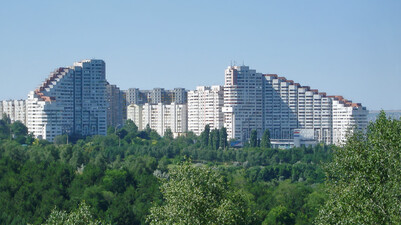
CHIȘINĂU (Kischinau, Chișinău, Кишинэу, Kischinjow, Кишинёв, Kişinöv), the seventh venue for the EVROVIZION project, is the capital city of the Republic of Moldova and was formerly the capital of the historical region of Bessarabia. In her novel “Kinderland” [A country of Children] published in 2015, Moldavian-born Liliana Corobca depicts her homeland as a country of children, because so many people have left the country to work abroad that children and the elderly make up much of what is left.
In the 16th century, Chișinău was part of the Ottoman Empire, and early in the 19th century it was incorporated into the Russian Empire. Over the course of the 20th century, Chișinău moved back and forth between Romanian and Soviet control, and the effects of this are evident to this day. Both Chișinău and the Republic of Moldavia have been – and continue to be – home to ethnic conflicts, including the Jewish pogrom of 1903 the persecution of the Jews during the Second World War, and the detachment of Russian and Ukrainian ethnic groups with the de facto state of Transnistria in the east and of Turkic-speaking people with the establishment of the autonomous region of Gagauzia in the southeastern part of the country. Even so, the city’s architecture and Chișinău’s cultural, social religious life continue to be characterised by diverse ethnic influences.
